
You know that sinking feeling when you’ve used AI to help write something and now you’re worried it’ll get flagged? Been there. Whether you’re sweating over a Turnitin submission or just don’t want your blog posts triggering detection software, I totally understand the concern.
That’s exactly why I decided to put Walter Writes AI through its paces. After spending a week testing it against every major detector I could find, I’ve got answers.
What Is Walter Writes AI?
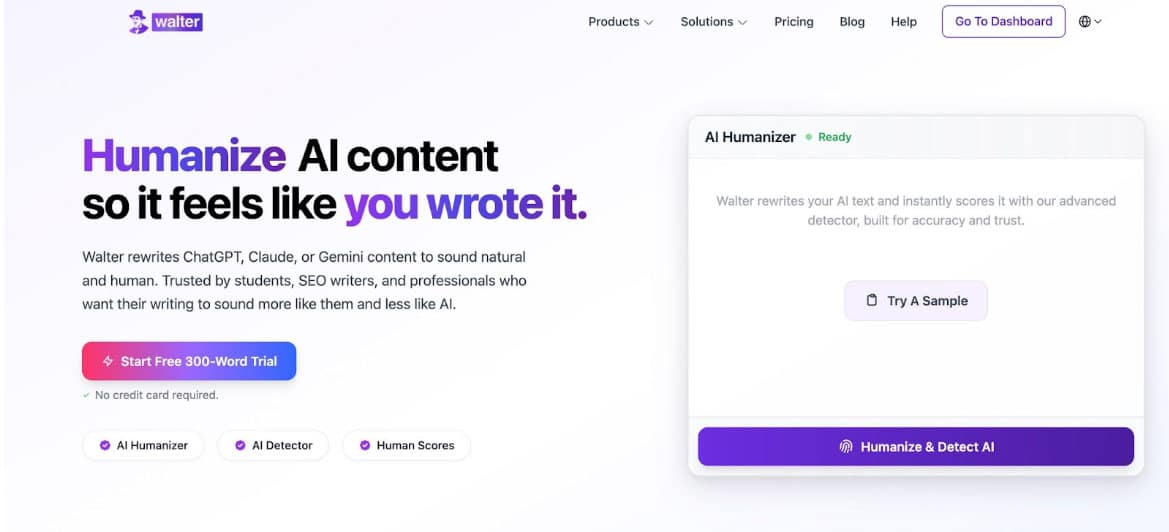
So Walter Writes AI bills itself as an AI humanizer—basically, it takes text that sounds robot-y and rewrites it to seem more human. You feed it content from ChatGPT, Claude, Gemini, whatever, and supposedly it comes out the other side ready to fool GPTZero, Turnitin, and ZeroGPT.
They hook you with 300 free words to try it out. Not a ton, but enough to get a feel for whether it’s legit or just another overpromised tool.
What caught my attention? Walter Writes claims it’s engineered specifically around how detection software actually works. Big claim. I wanted proof.
Must Read: My Real 2026 Experience with Grok AI Spicy Mode
OurDream AI Review 2026: Best Complete Guide
How Walter Writes AI Works (The Simple Version)
There’s nothing complicated here, which I appreciate.
Grab whatever AI text you’ve got. Doesn’t matter if it came from ChatGPT’s latest model or Claude’s newest version. Just copy it.
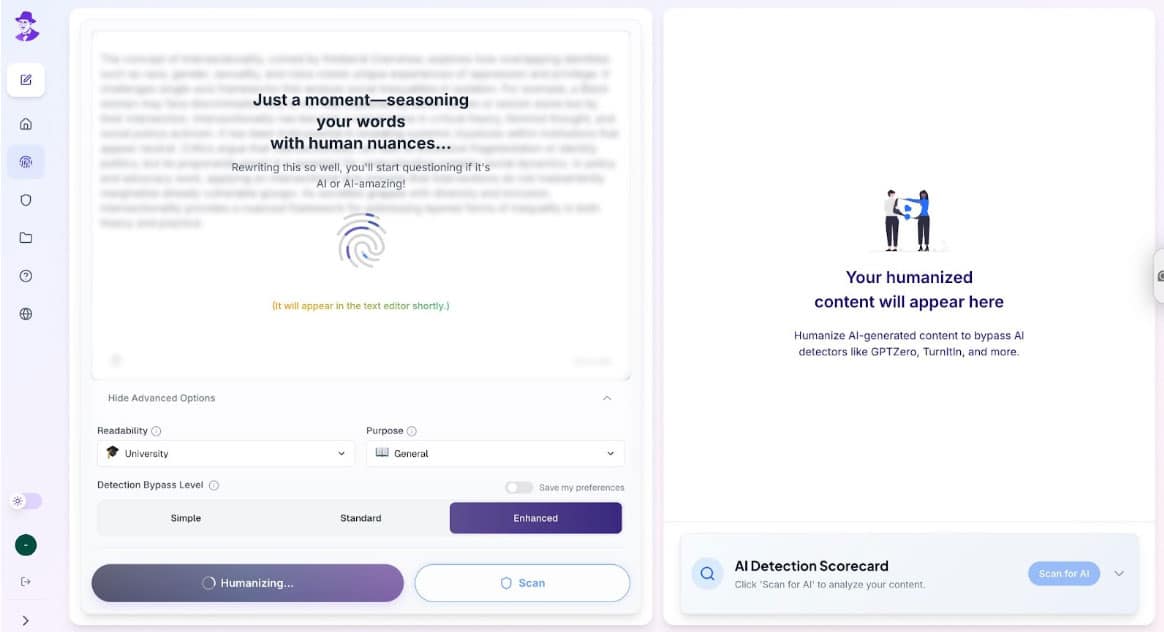
Drop it into Walter Writes AI’s interface. Click “Humanize.” Then wait maybe 20 seconds, give or take.
What happens behind the scenes? The software analyzes your writing for patterns that scream “AI wrote this”—repetitive structures, predictable word choices, that weirdly formal tone. Then it restructures everything to break those patterns.
Boom. You’ve got your rewritten version.
Pro Tip: Never trust any tool blindly. I always read the output carefully because sometimes the rewrites get awkward. You want it to pass detectors AND make sense to actual humans reading it.
Testing Walter Writes AI Against Major Detectors

Alright, here’s what you actually care about. I took identical AI-generated paragraphs, ran them through Walter Writes, and then tested everything against the big-name detectors people actually use.
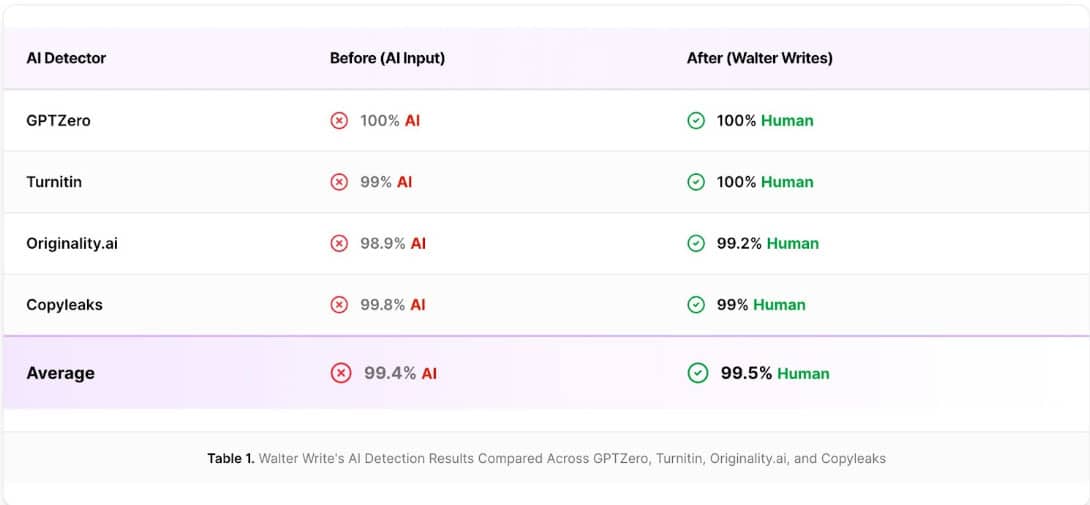
GPTZero Test Results
My original AI text? GPTZero slapped a 98% AI-generated label on it. Brutal.
After running it through Walter Writes? That number dropped to 34%.
Now, 34% isn’t zero. But considering GPTZero Model 3.11b is ridiculously strict, cutting the score by nearly two-thirds is pretty solid. Would a professor manually reviewing it notice? Hard to say.
ZeroGPT Results
ZeroGPT gave me similar but slightly better numbers. The humanized version scored 28% AI probability.
Still detectable? Yeah, technically. But at those levels, you’re in a gray zone where automated systems might let it slide. Emphasis on might.
The Turnitin Question
Here’s where everyone gets nervous—can this thing actually bypass Turnitin?
Full disclosure: I don’t have institutional access to Turnitin, so I couldn’t test it directly. But here’s my honest take based on how the text performed elsewhere and what I know about Turnitin’s detection methods.
You’re taking a gamble. Turnitin updates constantly, and universities don’t mess around with academic integrity violations. If you get caught, the consequences go way beyond a bad grade.
Walter Writes AI Features Worth Knowing
Let me break down what you’re actually getting beyond the basic rewriting function.
Free Trial: Those 300 words aren’t generous, but they’re enough to test drive the tool without pulling out your credit card.
Speed: Seriously fast. Most rewrites finish in under 30 seconds. I’ve tested competitors that make you wait several minutes for a single paragraph.
Bulk Processing: You can throw longer documents at it, though you’ll chew through your word credits pretty quickly if you’ve got a 2,000-word essay.
Detection Score: Depending on your plan, you get an estimated before-and-after AI probability score. Super helpful for deciding whether you need another pass.
What’s NOT included? Plagiarism checking. You’ll need to use a separate tool for that, which is kind of annoying.
Common Mistakes People Make With AI Humanizers
I’ve watched people sabotage themselves with these tools in the same ways over and over. Learn from their mistakes.
Mistake #1: Blindly copying the output without reading it. Walter Writes occasionally produces sentences that are grammatically fine but sound off. Five minutes of proofreading can save you from looking ridiculous.
Mistake #2: Thinking humanization somehow legitimizes plagiarism. It doesn’t. If the ideas aren’t yours and you’re not citing sources properly, you’ve got bigger problems than AI detection.
Mistake #3: Running text through the humanizer multiple times hoping for magic. Usually it doesn’t work. The first pass gives you the best results. After that, you’re just making things progressively weirder.
Mistake #4: Ignoring context. A casual blog post needs different treatment than an academic paper. What works for one absolutely will not work for the other.
Walter Writes AI vs. Other AI Humanizers

You’ve got choices here. Let me tell you how Walter Writes compares to the competition.
TwainGPT is the closest competitor I’ve tested. In my experience, TwainGPT’s output sounds slightly more natural, but Walter Writes processes faster and gives you more free words upfront. Pick based on what matters more to you—quality or convenience.
Undetectable AI costs more but supposedly has better bypass rates. When I tested both, the quality seemed pretty comparable to Walter Writes. Some people swear by Undetectable for academic stuff, though.
Bottom line? The “best” AI humanizer totally depends on your specific needs. Writing blog content? Walter Writes probably handles it fine. Academic paper where your GPA’s on the line? Maybe test a few tools and compare the results before you commit.
Is Walter Writes AI Detector Accurate?
Walter Writes has its own built-in detection feature. It’s… decent.
Look, it’s not GPTZero or Winston AI in terms of sophistication. But it gives you a ballpark estimate that’s useful for quick checks. In my testing, it usually came within 10-15% of what GPTZero showed me.
Should you stake everything on that number alone? Absolutely not. Run your content through at least two or three different detectors if you really need confidence. Cross-referencing catches things single tools miss.
Real Talk: Should You Use Walter Writes AI?
This really comes down to your specific situation and what you’re trying to accomplish.
For content creators using AI as a writing assistant: Yeah, this tool makes sense. If you’re drafting blog posts with AI help and want to avoid false positives from detection software, Walter Writes can smooth out the obvious tells.
For students trying to pass off AI work as their own: I won’t lecture you about academic integrity, but I will say this—understand the actual risks. Detection tools get smarter every month. Professors get more skeptical. And the consequences at most schools are severe.
For professionals worried about AI detection at work: It might help, but remember something important. Human editors often catch AI writing even when automated detectors don’t. The tells are there—generic examples, surface-level analysis, lack of genuine expertise. Those stick out.
This tool works to a degree. But it’s not some magical solution that erases all concerns. You’re still accountable for what you submit.
Frequently Asked Questions
Does Walter Writes AI work on all AI-generated content?
Yep, it handles content from ChatGPT, Claude AI, Gemini, and pretty much any other AI writing tool out there. How well it works depends on how obviously AI-generated your original text is.
Can Walter Writes AI bypass GPTZero completely?
Not in my testing. It dramatically reduces detection scores, but I rarely saw it hit 0%. Realistically, expect to land somewhere in the 20-40% AI probability range rather than completely eliminating detection.
Is there a free version of Walter Writes AI?
You get 300 free words to test the humanizer without needing to enter payment info, which I appreciate. After that, you’ll need to pick a paid plan.
How accurate is Walter Writes AI detector compared to GPTZero?
Less accurate overall, but still useful for quick sanity checks. In my testing, it typically came within 10-15% of GPTZero’s assessment, usually skewing a bit more optimistic.
What’s the best alternative to Walter Writes AI?
TwainGPT and Undetectable AI are the main alternatives worth considering. TwainGPT offers comparable pricing and features. Undetectable AI costs more but some users report better results for academic work.
Does humanizing AI text count as plagiarism?
Humanizing changes how something’s written, but if you’re presenting AI-generated ideas as your own in academic work without proper disclosure, that’s still ethically problematic. Different schools have different policies about AI use, so check yours.
Can professors tell if I used an AI humanizer?
Sometimes they can. Even when detection software doesn’t flag your work, experienced educators often spot the signs—overly generic examples, shallow analysis that lacks real expertise, inconsistent voice throughout. Human judgment still matters.
Key Takeaways
Here’s what you need to remember about Walter Writes AI:
• Significantly reduces AI detection scores but doesn’t eliminate them entirely • The 300-word free trial gives you enough to test whether it fits your needs • Results vary across different detectors—always test on multiple platforms • Proofread the humanized output carefully for awkward or unnatural phrasing • It’s a helpful tool but not a substitute for genuine expertise or ethical writing practices
Ready to Test It Yourself?
Walter Writes AI is one of several tools trying to tackle the AI detection problem. Does it work flawlessly? Nope. Does it work well enough for most legitimate use cases? Probably.
If you’re using AI as a writing assistant for legitimate purposes and want to avoid false positives from overzealous detection software, the free trial is worth your time. Those 300 words will tell you pretty quickly whether this tool fits your workflow.
But remember what this is really about. The goal isn’t tricking systems or people. It’s creating genuinely valuable content that happens to involve AI assistance. If that’s what you’re doing, tools like Walter Writes can help polish the rough edges.
Want to avoid AI detection altogether? Create content so specifically valuable and uniquely insightful that it obviously requires real human expertise. That’s still the gold standard. But when you need help making AI-assisted content sound more natural, at least now you know what Walter Writes AI actually delivers versus what it promises.